

Best Seats for the Most Popular West End Musicals (By Theatre and Budget)
Finding the best West End seat is not about chasing the most expensive row. It is about matching each musical, theatre layout, and budget to your viewing goal. This guide shows where to sit, what to avoid, and how to compare smarter options before booking confidently this season.
How to Use This Guide in 60 Seconds
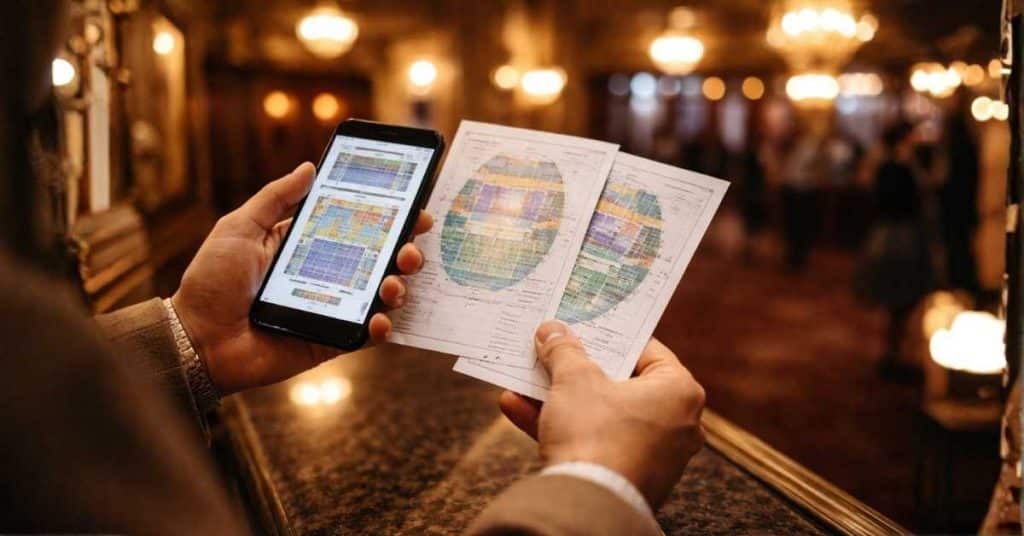
This guide is built for fast decisions. In one minute, you can shortlist the right section, avoid common seat traps, and focus your budget where it actually improves the experience.
-
Step 1: Pick your goal.
Decide what matters most for this booking: immersion (close, emotional detail),
full-stage view (better choreography and scene geometry), or price (best acceptable view for less). -
Step 2: Jump to your show.
Go directly to your musical’s section and use the theatre-specific recommendations.
Every West End venue behaves differently, so show-by-show guidance is more reliable than generic seating advice. -
Step 3: Use the budget tier map and avoid-zone rules.
Compare Premium, Smart Value, and Budget-Safe picks, then remove high-risk seats
(extreme sides, front-rail issues, steep top corners). Finally, compare section/date combinations on MusicalsAndTickets.co.uk before checkout.
Quick reminder: the “best seat” is the one that matches your goal, not the one with the highest price tag.
London Seating Terms You Must Decode First
Before you compare prices, decode the tier names. In the West End, section labels are similar across theatres, but not identical.
If you skip this step, you can easily book a seat that looks right on paper but feels wrong in practice.
Stalls
Ground-level seating closest to the stage. Usually strongest for facial detail and immediacy, but very front rows can reduce full-stage perspective.
Dress Circle / Royal Circle
The first elevated tier above Stalls. Some venues call this level Dress Circle, others use Royal Circle.
It is often the most balanced option for stage composition and comfort.
Upper Circle / Grand Circle
Higher-level seating with a broader top-down view and typically lower pricing. Depending on the venue, this level may be named
Upper Circle or Grand Circle.
Balcony
Often the topmost tier, but terminology varies. In some theatres, “Balcony” is a distinct label; in others, top-level seats are grouped under circle naming instead.
Why This Causes Confusion
The critical issue is naming inconsistency: one theatre’s “Royal Circle” can function like another theatre’s “Dress Circle,” and one venue’s “Balcony” can overlap with another venue’s top-circle concept.
“Seating plans are guides, not exact guarantees.”
Practical takeaway: some theatres use Royal / Grand / Balcony, while others use Dress / Upper or mostly Circle-based labels.
Always judge the exact row and angle on that theatre’s seating map before checkout.
Budget Framework Before Show-by-Show Picks
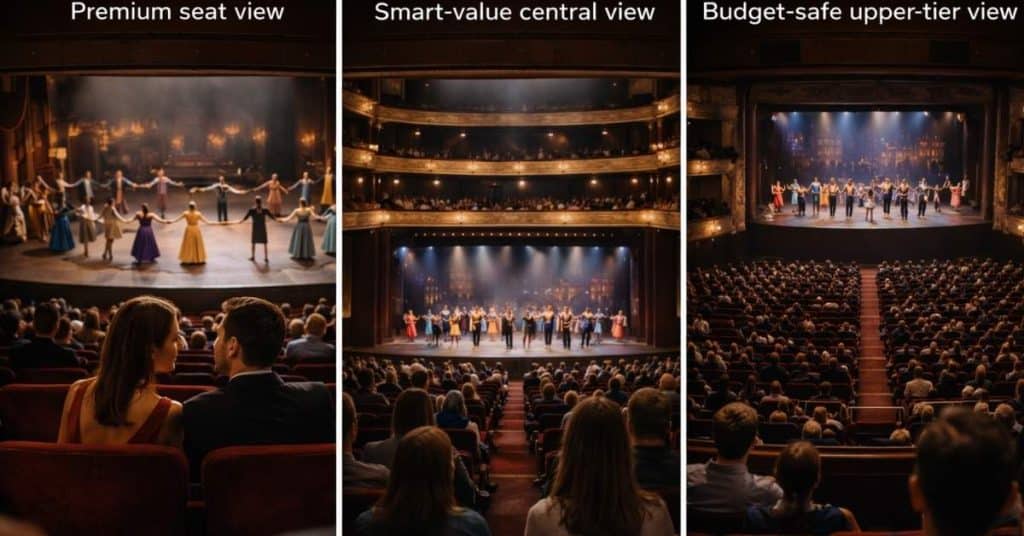
Before choosing seats for a specific musical, set a clear budget strategy. This prevents overpaying for hype rows and helps you focus on seats that deliver the strongest real-world experience for your spend.
Define Your Budget Tier First
Use these three editorial buckets to simplify decisions:
-
Premium: Highest-impact seats with the strongest combination of detail, angle, and comfort.
Best for special occasions, first-time “must-get-it-right” visits, or productions where staging detail matters deeply. -
Smart Value: The performance-to-price sweet spot.
Usually central seats in strong mid tiers where quality is close to premium but cost is meaningfully lower. -
Budget-Safe: Lowest-cost seats that still preserve a functional view and enjoyable experience.
Best for flexible plans, repeat visits, students, and price-first buyers.
Understand Dynamic Pricing Before You Click “Buy”
West End ticket pricing is dynamic, which means prices shift based on demand, date, performance time, holidays, and remaining inventory.
Because of this, a weekday or off-peak seat in a stronger zone can sometimes cost the same as (or less than) a weaker seat on a prime weekend slot.
- Prime dates: Fridays, Saturdays, school breaks, holiday periods.
- Off-peak opportunities: midweek performances, selected matinees, non-holiday windows.
- Practical result: timing flexibility can outperform section compromises.
Do Not Anchor to One Price Snapshot
Ticket ranges are broad, and promotional offers can appear throughout the year.
One listing at one moment is not the market truth for that show. If you anchor to a single snapshot, you risk paying more for less.
- Check multiple dates for the same show before deciding.
- Compare adjacent seat clusters, not one isolated seat.
- Re-check prices if your schedule allows even a small date shift.
Fast Value Rule
Start with Smart Value, upgrade only when the extra cost clearly fixes a real issue (bad angle, obstruction, comfort),
and drop to Budget-Safe when the show style still supports a strong overall view from higher tiers.
The 5-Minute Seat Selection Method (Reusable)
Use this quick framework every time you book a West End musical. It keeps decisions focused, avoids common seat traps, and helps you get better value without overthinking.
-
Choose one priority only: immersion, composition, comfort, or budget.
Pick the single outcome you care about most for this specific show. One clear priority prevents conflicting choices and cuts decision noise.
-
Shortlist two sections max.
Limit your comparison to two tiers (for example, Stalls + Dress Circle, or Dress Circle + Upper Circle). This speeds up evaluation and keeps trade-offs realistic.
-
Eliminate high-risk zones.
Remove extreme side seats, front-row rail-risk seats, and steep top-corner positions early. You will avoid most regret by filtering these out before price comparison.
-
Compare clusters, not single impulse seats.
Review 3–5 adjacent seats or nearby rows in the same area. Small position changes often improve angle and comfort for little or no extra cost.
-
Compare nearby dates and times before checkout.
Check the same seat zones across nearby performances on MusicalsAndTickets.co.uk. A minor date or time shift can unlock stronger seats at a better price.
Quick rule: optimize for fit, not label. The best seat is the one that matches your priority with the lowest compromise.
Show-by-Show Recommendations (By Theatre and Budget)

The Lion King — Lyceum Theatre
Theatre Profile Snapshot
This show rewards both immersion and full-stage geometry. You want clean sightlines for puppetry, ensemble movement, and large visual tableaux. Family bookings should prioritize central alignment and predictable head-clearance.
Premium Picks (Best Detail/Impact)
- Central mid-Stalls for emotional intensity and close performance detail.
- Front-central first elevated tier for a panoramic read of large stage pictures.
Smart Value Picks (Best Balance)
- Central Circle rows with balanced height and strong full-stage readability.
- A row or two behind prime pricing often performs similarly for less.
Budget-Safe Picks (Lowest Regret)
- Central Upper/Grand Circle seats where possible.
- Avoid extreme corners if booking for children.
Seats to Verify or Avoid
- Very front rows if you dislike neck tilt.
- Extreme sides where choreography and entrances can crop.
- Any restricted-view label that affects full-stage patterns.
Best For
- First-timers: central Circle.
- Families: central rows with easy aisle access.
- Repeat viewers: value Upper Circle centers.
- Tall guests: aisle seats with easier legroom.
- Short guests: avoid flatter rows with head-block risk.
Value Verdict
Pay extra for angle correction, not proximity hype.
The Phantom of the Opera — His Majesty’s Theatre
Theatre Profile Snapshot
Naming can appear as Stalls, Royal Circle, Grand Circle, and Balcony depending on map style. Prioritize orchestral blend and stage composition over “closest possible.”
Premium Picks (Best Detail/Impact)
- Central Stalls (not ultra-front) for detail plus manageable perspective.
- Central Royal Circle for a strong balance of vocals and staging.
Smart Value Picks (Best Balance)
- Mid Royal Circle rows often deliver premium-like clarity at lower cost.
- Select central blocks before paying for row prestige.
Budget-Safe Picks (Lowest Regret)
- Central Grand Circle seats with clear frontal angle.
- Top-tier center can work well if steepness is comfortable for you.
Seats to Verify or Avoid
- Front-rail interference in elevated front rows.
- Extreme side seats with partial scenic cropping.
- Upper-tier corners if steep stairs or vertigo are concerns.
Best For
- First-timers: central Royal Circle.
- Music-focused guests: elevated central zones.
- Repeat viewers: value-focused Grand Circle center.
- Tall guests: aisle positions for comfort.
- Short guests: stronger rake preferred.
Value Verdict
Pay extra for angle correction, not proximity hype.
Mamma Mia! — Novello Theatre
Theatre Profile Snapshot
High-energy pacing rewards immersion, but side-angle distortion can undercut group numbers. This is a strong candidate for value-driven repeat visits.
Premium Picks (Best Detail/Impact)
- Central mid-Stalls for energetic engagement and expression detail.
- Front-central Circle for balanced choreography visibility.
Smart Value Picks (Best Balance)
- Central Circle rows with moderate elevation and strong stage coverage.
- One or two rows off the peak price line often give similar quality.
Budget-Safe Picks (Lowest Regret)
- Central Upper Circle seats with direct frontal sightlines.
- Best for spontaneous plans and returning fans.
Seats to Verify or Avoid
- Extreme side Stalls for choreography-heavy sequences.
- Any seat marked restricted where entrances are affected.
- Top-tier corners if stairs are a comfort issue.
Best For
- First-timers: central Circle.
- Families/friends groups: central blocks with easy access.
- Repeat viewers: value Upper Circle center.
- Tall guests: aisle rows over proximity.
- Short guests: prioritize stronger rake lines.
Value Verdict
Pay extra for angle correction, not proximity hype.
Matilda The Musical — Cambridge Theatre
Theatre Profile Snapshot
Family bookings dominate decision-making here: clear sightlines, manageable stairs, and minimal head-block risk are often more important than extreme closeness.
Premium Picks (Best Detail/Impact)
- Central mid-Stalls for close acting detail and strong connection.
- Front-central Circle for a fuller view of ensemble staging.
Smart Value Picks (Best Balance)
- Central Circle rows offer dependable all-round viewing for mixed-age groups.
- Great compromise when adults and children share one booking.
Budget-Safe Picks (Lowest Regret)
- Central Upper Circle with straightforward frontal perspective.
- Prefer rows with easier access for interval movement.
Seats to Verify or Avoid
- Flatter rows behind likely head-block lines.
- Extreme side angles where staging corners can clip.
- Very steep top-corner seats for younger children.
Best For
- First-timers: central Circle.
- Families: central rows + aisle practicality.
- Repeat viewers: budget-safe upper center.
- Tall guests: aisle choices.
- Short guests: prioritize rake and centrality.
The Devil Wears Prada — Dominion Theatre
Theatre Profile Snapshot
Large-capacity room behavior makes distance management critical. A seat that is technically centered but too far back can feel visually detached for detail-led scenes.
Premium Picks (Best Detail/Impact)
- Central Stalls in strong mid rows for impact and readable detail.
- Front-central Circle for broad composition with less neck strain.
Smart Value Picks (Best Balance)
- Central Circle rows often deliver the best balance in large auditoriums.
- Target rows where stage width remains coherent without over-distance.
Budget-Safe Picks (Lowest Regret)
- Central upper-level options that preserve direct frontal geometry.
- Prefer closer rows within the budget tier to reduce distance fatigue.
Seats to Verify or Avoid
- Far-rear positions where facial detail drops sharply.
- Extreme sides that flatten scene depth.
- Front rail/overhang interactions in transition rows.
Best For
- First-timers: central Circle or mid-Stalls.
- Style/visual fans: balanced frontal zones.
- Repeat viewers: upper center value bands.
- Tall guests: aisle strategy.
- Short guests: avoid flat rear lines.
Value Verdict
Pay extra for angle correction, not proximity hype.
Back to the Future — Adelphi Theatre
Theatre Profile Snapshot
Effects readability and balanced frontal framing matter as much as closeness. This is a show where composition can beat raw proximity.
Premium Picks (Best Detail/Impact)
- Central mid-Stalls for strong immersion and key visual moments.
- Front-central Circle for full-stage effects coherence.
Smart Value Picks (Best Balance)
- Central Circle rows typically provide the best all-round return.
- Great for viewers who want spectacle without premium overpay.
Budget-Safe Picks (Lowest Regret)
- Central Upper Circle seats with direct angle to the stage center.
- Choose rows that minimize vertical cropping risk.
Seats to Verify or Avoid
- Extreme sides for effects-heavy sequences.
- Very front rows if you prefer full visual geometry over intimacy.
- Steep top corners if height sensitivity applies.
Best For
- First-timers: central Circle.
- Families/teens: balanced central rows.
- Repeat viewers: budget upper center.
- Tall guests: aisle and legroom-first picks.
- Short guests: stronger rake rows.
Value Verdict
Pay extra for angle correction, not proximity hype.
Hamilton — Victoria Palace Theatre
Theatre Profile Snapshot
Lyric clarity and choreography framing are the core priorities. Central elevated choices often outperform very close rows when you want both verbal detail and full movement patterns.
Premium Picks (Best Detail/Impact)
- Central mid-Stalls for immediacy and expressive performance detail.
- Central first elevated tier for balanced lyrical clarity and stage geometry.
Smart Value Picks (Best Balance)
- Central Circle rows where speech clarity and ensemble spacing stay consistent.
- One-tier-down pricing steps can be high-value with minimal quality loss.
Budget-Safe Picks (Lowest Regret)
- Central Upper Circle where available with direct stage center view.
- Prefer nearer rows in budget tier to support lyric intelligibility.
Seats to Verify or Avoid
- Extreme sides where rapid staging can clip transitions.
- Very front rows if you prioritize composition over intimacy.
- Any rail/overhang interaction in front elevated rows.
Best For
- First-timers: central Circle.
- Lyrics-first viewers: balanced elevated central blocks.
- Repeat viewers: upper center value strategy.
- Tall guests: aisle and legroom planning.
- Short guests: avoid flatter head-block zones.
Value Verdict
Pay extra for angle correction, not proximity hype.
The Book of Mormon — Prince of Wales Theatre
Theatre Profile Snapshot
Comedy timing and dialogue intelligibility drive enjoyment. You want clear vocal delivery and enough perspective to track ensemble reactions without visual strain.
Premium Picks (Best Detail/Impact)
- Central mid-Stalls for facial expression and comic reaction detail.
- Front-central Circle for balanced comedy staging and timing cues.
Smart Value Picks (Best Balance)
- Central Circle rows with clean frontal orientation.
- Excellent low-regret option for most first-time viewers.
Budget-Safe Picks (Lowest Regret)
- Central upper-tier seating with direct sightline to stage center.
- Strong for spontaneous bookings and flexible plans.
Seats to Verify or Avoid
- Extreme side seats where dialogue staging can clip.
- Front-rail rows with potential lower-stage obstruction.
- Steep top-corner positions if comfort is a priority.
Best For
- First-timers: central Circle.
- Comedy-focused viewers: central blocks for timing clarity.
- Repeat viewers: budget upper center.
- Tall guests: aisle-first strategy.
- Short guests: prioritize stronger rake.
Value Verdict
Pay extra for angle correction, not proximity hype.
Moulin Rouge! The Musical — Piccadilly Theatre
Theatre Profile Snapshot
Visual extravaganza demands strong width control and clean centrality. Hyper-close seats can feel thrilling, but broad composition often wins for this production style.
Premium Picks (Best Detail/Impact)
- Central mid-Stalls for immersive spectacle and performer detail.
- Front-central Circle for wide compositional coherence.
Smart Value Picks (Best Balance)
- Central Circle rows where visual density stays readable.
- Often near-identical practical quality to pricier close rows.
Budget-Safe Picks (Lowest Regret)
- Central Upper Circle seats with direct frontal orientation.
- Choose center first; avoid drifting too far lateral.
Seats to Verify or Avoid
- Extreme side angles for large ensemble and layered set moments.
- Very front rows if you want full visual geometry.
- Top-tier corners when steepness may reduce comfort.
Best For
- First-timers: central Circle for full-stage wow factor.
- Date night/special occasion: premium central zones.
- Repeat viewers: upper center value bands.
- Tall guests: aisle and comfort-first picks.
- Short guests: avoid flatter blocked rows.
Les Misérables — Sondheim Theatre
Theatre Profile Snapshot
Long runtime makes comfort and sound blend essential. The best strategy balances vocal intelligibility, orchestral cohesion, and physical ease for the full performance length.
Premium Picks (Best Detail/Impact)
- Central mid-Stalls for strong acting detail and emotional intensity.
- Front-central Circle for broader composition with excellent musical balance.
Smart Value Picks (Best Balance)
- Central Circle rows often offer the strongest value-to-quality ratio.
- Ideal for iconic high-demand dates when premium jumps are steep.
Budget-Safe Picks (Lowest Regret)
- Central Upper/Grand Circle seats where sound and geometry remain coherent.
- Prefer rows with manageable access for interval comfort.
Seats to Verify or Avoid
- Extreme sides where major scenic beats can crop.
- Tight comfort rows for long-runtime visits.
- Steep top corners if mobility or vertigo is a concern.
Best For
- First-timers: central Circle.
- Music-focused audiences: elevated central blend zones.
- Repeat viewers: budget upper center choices.
- Tall guests: aisle and legroom priority.
- Short guests: stronger rake, central lines.
Value Verdict
Pay extra for angle correction, not proximity hype.
Wicked — Apollo Victoria Theatre
Theatre Profile Snapshot
Large-capacity venue logic applies: rear distance management is crucial. A balanced central placement usually beats extreme proximity or far-rear compromise for first-time trips.
Premium Picks (Best Detail/Impact)
- Central mid-Stalls for immersive dramatic impact.
- Front-central Circle for a clean full-stage read.
Smart Value Picks (Best Balance)
- Central Circle rows that preserve both spectacle and clarity.
- Strong first West End trip default when you want low regret.
Budget-Safe Picks (Lowest Regret)
- Central upper-tier choices with direct frontal view.
- Avoid very rear corners where distance can flatten detail.
Seats to Verify or Avoid
- Far-rear and extreme side combinations.
- Rows with rail/overhang conflicts.
- Steep corners for height-sensitive guests.
Best For
- First West End trip: central Circle.
- Families: central rows + easy movement.
- Repeat viewers: upper center value.
- Tall guests: aisle strategy.
- Short guests: stronger rake positions.
Value Verdict
Pay extra for angle correction, not proximity hype.
MJ The Musical — Prince Edward Theatre
Theatre Profile Snapshot
Dance geometry and rhythm-driven staging make compositional balance critical. You want seats that preserve full-body movement lines while keeping enough detail for performance nuance.
Premium Picks (Best Detail/Impact)
- Central mid-Stalls for energy and performer detail.
- Front-central Circle for complete choreography framing.
Smart Value Picks (Best Balance)
- Central Circle rows with strong visual coherence for dance-heavy scenes.
- Great option for one-night trips balancing impact and affordability.
Budget-Safe Picks (Lowest Regret)
- Central upper-tier seats with direct sightline to stage center.
- Best when budget is fixed but stage geometry still matters.
Seats to Verify or Avoid
- Extreme side seats where choreography reads unevenly.
- Very front rows if you prefer full compositional context.
- Steep top-corner positions for comfort-sensitive guests.
Best For
- First-timers: central Circle.
- Dance-focused viewers: balanced frontal zones.
- Repeat viewers: upper center value tiers.
- Tall guests: aisle/legroom-first seating.
- Short guests: avoid flatter head-block lines.
Value Verdict
Pay extra for angle correction, not proximity hype.
Side-by-Side Master Decision Table
Use this matrix as your fast booking grid. Pick your show, choose the zone that matches your goal, then check the risk note before comparing dates and prices.
| Show | Theatre | Best Premium Zone | Best Smart-Value Zone | Best Budget-Safe Zone | Main Risk Zone | Best For (first-timers/families/repeat viewers) | Value Note |
|---|---|---|---|---|---|---|---|
| The Lion King | Lyceum Theatre | Central mid-Stalls | Central Circle rows | Central Upper/Grand Circle | Extreme sides, very front neck-tilt rows | First-timers: Circle / Families: central rows / Repeat: upper-center value | Pay extra for central angle and child-friendly sightlines, not row prestige. |
| The Phantom of the Opera | His Majesty’s Theatre | Central Stalls (not ultra-front) or central Royal Circle | Mid Royal Circle center blocks | Central Grand Circle | Front rail interference, steep upper corners | First-timers: Royal Circle / Families: central rows / Repeat: Grand Circle center | Prioritize sound blend + composition over closest proximity. |
| Mamma Mia! | Novello Theatre | Central mid-Stalls | Central Circle rows | Central Upper Circle | Extreme side angles in choreography-heavy moments | First-timers: Circle / Families: central blocks / Repeat: value upper-center | Energy show: center alignment matters more than front-row hype. |
| Matilda The Musical | Cambridge Theatre | Central mid-Stalls or front-central Circle | Central Circle (family-friendly balance) | Central Upper Circle with clear rake | Flat head-block rows, steep top corners for kids | First-timers: Circle / Families: central + aisle ease / Repeat: upper-center value | For mixed adult/child groups, buy sightline reliability before proximity. |
| The Devil Wears Prada | Dominion Theatre | Central mid-Stalls | Central Circle rows | Central upper-level near-front rows | Far-rear distance zones, extreme sides | First-timers: Circle / Families: central rows / Repeat: upper-center value | Large auditorium: pay to reduce distance, not to sit marginally closer. |
| Back to the Future | Adelphi Theatre | Central mid-Stalls or front-central Circle | Central Circle (effects-friendly framing) | Central Upper Circle | Extreme sides, very front rows for full-effects reading | First-timers: Circle / Families: central rows / Repeat: upper-center value | Choose seats that keep effects readable and stage geometry intact. |
| Hamilton | Victoria Palace Theatre | Central mid-Stalls or central elevated front rows | Central Circle rows | Central Upper Circle (nearer rows) | Extreme sides, rail/overhang interactions | First-timers: Circle / Families: central blocks / Repeat: upper-center value | Lyric clarity + choreography framing often beat very close seating. |
| The Book of Mormon | Prince of Wales Theatre | Central mid-Stalls | Central Circle rows | Central upper tier | Extreme sides that weaken dialogue staging | First-timers: Circle / Families: central rows / Repeat: upper-center value | Comedy timing depends on clear dialogue—buy intelligibility first. |
| Moulin Rouge! The Musical | Piccadilly Theatre | Central mid-Stalls | Central Circle rows | Central Upper Circle | Extreme sides, top-corner steepness | First-timers: Circle / Families: central rows / Repeat: upper-center value | For spectacle, wide composition usually beats hyper-close immersion. |
| Les Misérables | Sondheim Theatre | Central mid-Stalls or front-central Circle | Central Circle (long-runtime comfort + blend) | Central Upper/Grand Circle | Tight-comfort rows, extreme sides, steep corners | First-timers: Circle / Families: central + easy access / Repeat: upper-center value | For long shows, comfort + orchestral balance are worth paying for. |
| Wicked (Optional) | Apollo Victoria Theatre | Central mid-Stalls | Central Circle rows | Central upper-level near-front rows | Far-rear corners with heavy distance effect | First-timers: Circle / Families: central rows / Repeat: upper-center value | Large-capacity room: pay for better distance control, not label prestige. |
| MJ The Musical (Optional) | Prince Edward Theatre | Central mid-Stalls | Central Circle rows | Central upper-tier seats | Extreme sides in dance-heavy sequences | First-timers: Circle / Families: central rows / Repeat: upper-center value | Dance-driven show: prioritize frontal geometry over closeness hype. |
Price vs Value — When to Spend More (and When Not To)
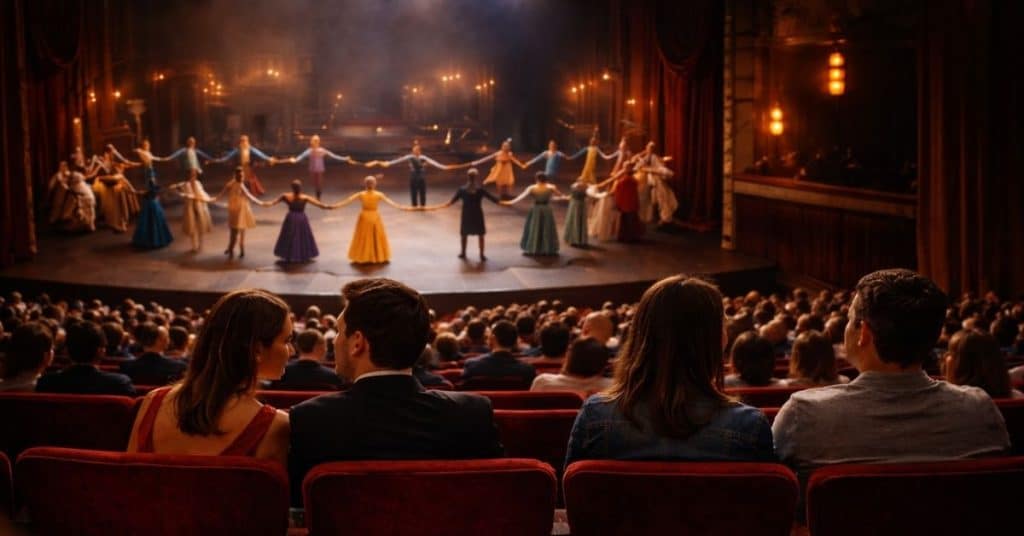
In West End booking, price is a signal, not a guarantee. Real value comes from what the seat fixes or improves in practice:
viewing angle, sightline reliability, comfort across runtime, and how well the seat fits the show’s staging style.
When Spending More Is Worth It
Pay up when the upgrade solves a concrete problem, not just when it moves you physically closer.
- Angle correction: moving from side-heavy perspective to a cleaner central view.
- Sightline clarity: reducing rail, head-block, or partial-cropping risk.
- Long-runtime comfort: better legroom, easier access, less neck strain for longer shows.
If the extra cost improves what you can actually see, hear, and tolerate for two-plus hours, it is usually money well spent.
When Saving Is the Smarter Move
Many mid-tier central seats perform almost the same as premium seats once the curtain rises.
- Central mid-tier rows often preserve full-stage readability and balanced acoustics.
- One-row or one-band-down options can deliver near-identical practical quality.
- Show-style match matters: for large visual productions, composition often beats extreme proximity.
If two options look similar in angle and comfort, keep the cheaper one and spend the difference elsewhere.
Use Date Flexibility to Upgrade Without Overpaying
Small schedule shifts can change value dramatically. A stronger seat on an off-peak performance can cost the same as a weaker seat on a prime date.
- Check nearby weekdays, matinees, and non-peak performance times.
- Compare the same section across multiple dates before checkout.
- Treat timing as a pricing lever, not just a calendar choice.
Fast Value Rule
Spend for correction, save on hype.
Upgrade when it fixes angle, clarity, or comfort. Save when central mid-tier seats already deliver the same real experience.
Mistakes That Cause Seat Regret
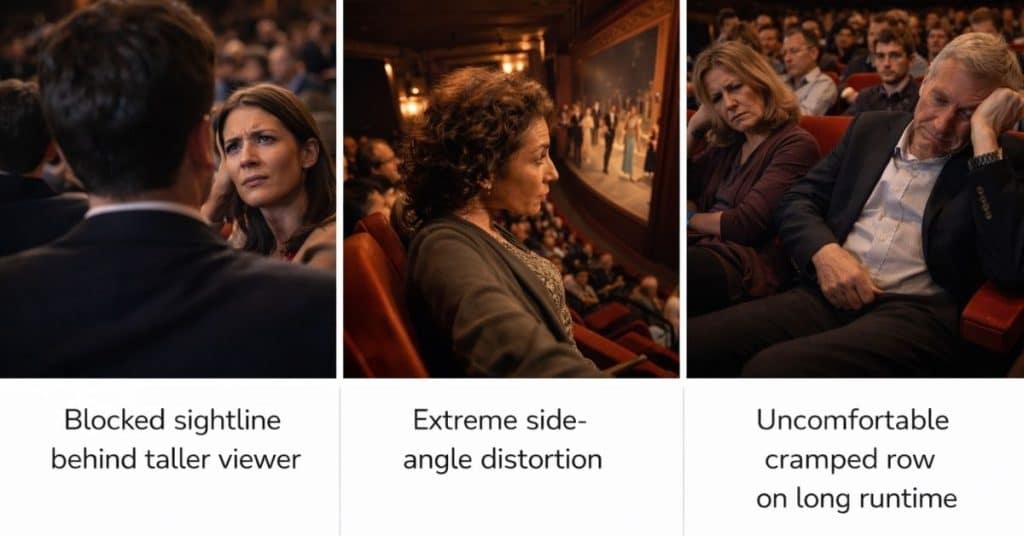
Most disappointing theatre bookings come from predictable decision errors, not bad luck.
If you avoid the mistakes below, your chance of getting a genuinely satisfying seat increases fast.
Assuming “Closer Is Always Better”
Closer can mean stronger facial detail, but it can also mean neck strain, cropped choreography, and weaker full-stage perspective.
For many musicals, a slightly elevated central view performs better overall than ultra-front proximity.
Ignoring Restricted-View Wording
Restricted view is not a minor disclaimer. It can range from a small corner cut to a meaningful loss of key moments.
Always treat this label as a serious quality signal, especially in visually dense productions.
Buying Extreme Side Seats for Choreography-Heavy Shows
Side extremes can distort spacing, hide entrances, and reduce the impact of big ensemble numbers.
If movement and staging geometry are central to the show, prioritize central alignment over raw closeness.
Ignoring Comfort on Long Performances
A technically good seat can still feel poor if comfort is compromised for two or three hours.
Legroom, row spacing, stair steepness, and easy interval movement matter more than most buyers expect.
Checking Only One Date/Time Before Purchase
Many people overpay because they compare seats on one performance only.
A nearby date or time can unlock better sections at similar or lower prices, so always compare before checkout.
Quick rule: optimize for sightline + comfort + show fit, not just “closest available.”
Accessibility and Practical Comfort Notes
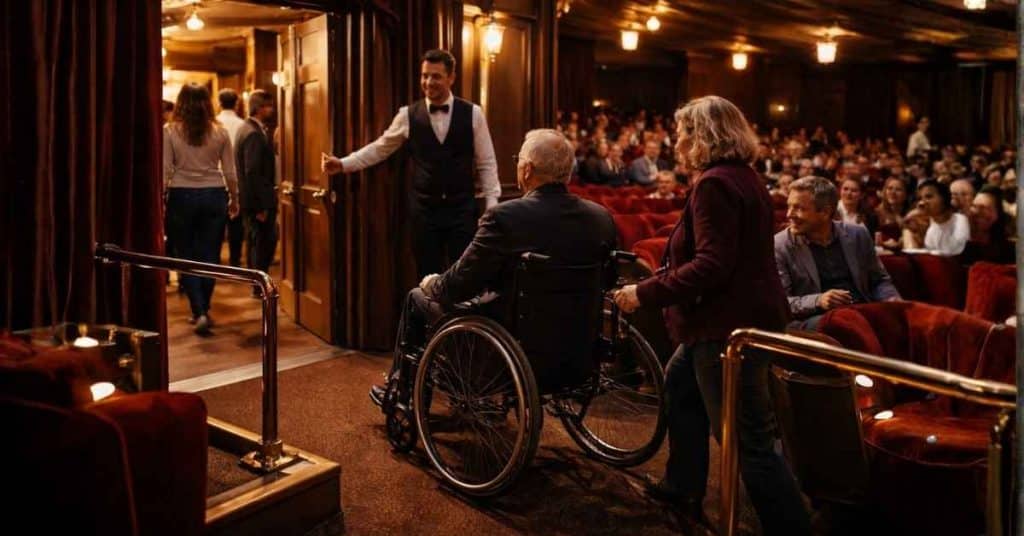
A seat can look perfect on price and view, then fail on access. In the West End, step-free availability and internal routes can vary significantly by theatre and by section, so accessibility should be checked before you commit to any booking.
Why Access Varies More Than Most People Expect
- Step-free entry may exist for one level but not for all seating tiers.
- Routes to seats can include extra stairs, narrow turns, or longer walking distances.
- Top levels often involve steeper climbs and more demanding movement.
Verify Theatre-Specific Details Before Purchase
Always review access notes directly on the performance seating map before checkout.
Do not rely on section names alone—two seats in the same zone can have very different practical access.
Access-First Checklist
- Stairs: Check total stair demand to your exact row and whether step-free alternatives are available.
- Interval movement: Confirm how easy it is to leave and return during busy intervals.
- Aisle practicality: Prefer seats with simpler entry/exit if frequent movement is likely.
- Row layout: Avoid tightly packed rows if legroom or mobility is a concern.
- Top-tier steepness: Verify comfort with steep gradients before choosing upper levels.
- Companion seating: Ensure your group can sit in a practical configuration, not just adjacent by number.
Practical rule: choose the seat you can enjoy for the full evening, not just the seat that looks best in a static map view.
Quick Cheat Sheet (Mobile Summary)
- Best all-round default: central Dress/Royal Circle equivalent.
- Most immersive: mid-central Stalls.
- Best budget compromise: central front Upper/Grand (after rail-angle check).
- Highest variance: top tiers and extreme side blocks.
Fast rule: choose center first, then optimize for comfort and price.
Conclusion — Choose Seats Like a Regular, Even on Your First Trip

You do not need insider knowledge to book well in the West End. You just need a repeatable process:
set your goal, build a two-section shortlist, apply a risk filter, then run a date/time comparison.
That sequence consistently beats impulse booking.
The core principle is simple: section names guide you, but row position, angle, comfort, and show fit decide the real outcome.
If you book by function instead of hype, you reduce regret and improve value—even on your first London theatre trip.
Frequently Asked Questions
Are Stalls always better than Dress Circle?
No. Stalls usually give stronger facial detail and immersion, but Dress Circle often gives a cleaner full-stage perspective.
For dance-heavy or visually complex musicals, central Dress Circle can outperform very close Stalls rows.
Is Upper Circle too far for musicals?
Not necessarily. Upper Circle can still deliver a very good experience, especially from central seats.
You may lose some facial detail, but you gain a broader view of stage geometry and often pay much less.
What does restricted view usually mean in practice?
It usually means part of the stage is blocked by a rail, overhang, pillar, or angle.
Sometimes the impact is minor; sometimes key moments are cut off. Treat restricted-view labels as a real risk, not just a discount tag.
Is Balcony the same as Upper/Grand Circle?
Sometimes similar, but not always identical. Naming varies by theatre.
One venue may call the top level Balcony, another may use Upper or Grand Circle for a comparable area.
Where should first-time West End visitors sit?
Central Dress/Royal Circle is usually the safest all-round choice.
It balances sightlines, composition, and comfort, which is ideal when you want low-regret seats for a first visit.
Which seats are best for tall people?
Prioritize aisle seats and rows known for better legroom over section prestige.
A comfortable mid-tier aisle seat is often better than a cramped premium seat.
Which seats are safest for kids?
Choose central rows with clear sightlines, manageable stairs, and easy interval access.
Avoid extreme side angles and very steep top corners, especially for younger children.
How do I find value seats for sold-out or high-demand shows?
Compare multiple dates and times, then compare seat clusters instead of single seats.
Keep two sections in play (for example, Circle + Upper) and avoid known risk zones first.
Do weekday performances usually improve value?
Often yes. Off-peak performances can offer stronger seats at similar or lower prices than peak weekend slots.
Small date changes can produce large value gains.
When is it worth paying for premium seats?
Pay more when the upgrade fixes a real problem: poor angle, weak sightline, or comfort limitations on a long runtime.
If a mid-tier central seat offers near-identical practical quality, save your money.